MediaTek announced the Dimensity 9600 Pro, a flagship smartphone chip built on a 2nm process. According to the company, its NPU 1090 supports on-device applications with models of up to 30B parameters. MediaTek reports 51% higher LLM prefill performance, the phase where the model reads the prompt, and 55% higher token generation per watt, measured on demo devices in its own labs.
The chip pairs the NPU 1090 with a second-generation Super Efficient NPU, which MediaTek says cuts power consumption for always-on AI by 40%. The platform supports LPDDR6 memory and UFS 5.0 storage.
In September 2025, MediaTek announced that it had completed the tape-out, the final design handoff to the fab, of a flagship chip on TSMC’s N2P 2nm process, with volume production expected in late 2026. The CPU uses a 2+3+3 layout of eight big cores, with two C2-Ultra cores at up to 4.55 GHz. MediaTek states up to 17% higher single-core and up to 15% higher multi-core performance over the previous generation, and up to 61% lower multi-core power consumption.
The first smartphones with the Dimensity 9600 Pro and the related Dimensity 9600M are expected to launch this quarter, according to MediaTek.
Arm has published five developer takeaways from Arm Create, its developer events in Shanghai and Shenzhen. Two of them concern on-device AI. Arm says model choice starts with the workload and not with model size alone, and that developers should decide which parts of an application stay on the device, which run on nearby edge infrastructure and which need the cloud. The Shenzhen panel included Alibaba Qwen, ModelBest, Tencent Hunyuan and Ultralytics.
In the Shanghai keynote, Shantu Roy, Arm’s VP of Developer Relations, discussed the Arm AI Portal. Arm says the portal lists models validated and optimized for Arm-based platforms, together with performance data for specific targets, code and deployment workflows. Coding agents can reach the same information through the Arm MCP Server.
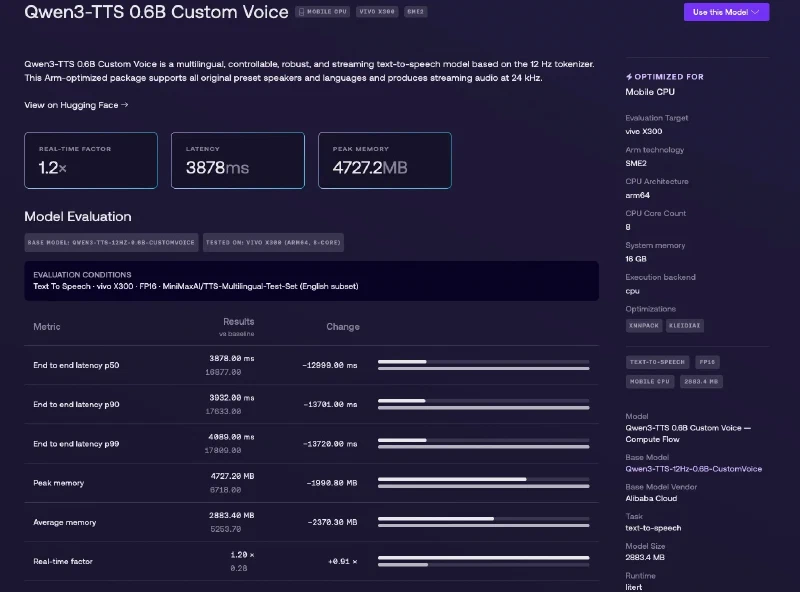
The recap shows the portal’s evaluation of Qwen3-TTS 0.6B Custom Voice, a multilingual streaming text-to-speech model from Alibaba, on a mobile CPU. The entry lists a vivo X300 with 8 CPU cores and 16 GB of memory, SME2, the XNNPACK and KleidiAI optimizations, FP16 weights and the LiteRT runtime. It reports a real-time factor of 1.2x against a baseline of 0.28x and a median end-to-end latency of 3,878 ms against 16,877 ms. Peak memory is 4,727 MB against 6,718 MB, and the evaluation uses the English subset of the MiniMaxAI TTS-Multilingual-Test-Set.
Evaluation results in the Arm AI Portal, as shown in Arm's recap. Source: Arm.
Arm also points to Arm CSS for Mobile 2, which combines the Arm C2 CPU Cluster with SME2 and the Mali G2-Ultra NX GPU. Arm says the platform supports new on-device AI experiences on mobile. The next Arm Create event moves to the US, and Arm has not given a date.
Samuel Zeng has released Edge0, an open-source framework for streaming mixture-of-experts inference, under Apache-2.0. In his launch post he reports a 35-billion-parameter model running on an iPhone at 1 to 2.5 GB of peak memory without a cloud connection.
The repository describes three techniques. Expert weights are streamed from storage on demand, so peak memory is bounded by the active set. A trained prerouter predicts expert routing one step ahead so that loads overlap the forward pass, which the project credits with up to 59 percent higher throughput. Recover-LoRA pairs an int4-quantised frozen base with distilled LoRA adapters.
Two tiers are published. edge0-35b has 40 layers and 256 experts, a checkpoint of roughly 23 GB and about 2.9 GiB of peak active memory. edge0-8b has 24 layers and 128 experts, a 4.2 GB checkpoint and about 1.0 GB peak. On a Mac mini M4 Pro with 24 GB, the project measures 14.9 to 17.7 tokens per second of decode for the 35B tier and 23.9 to 25.3 for the 8B tier, with prefill at 113 tokens per second cold and 140 warm for 35B. Quality loss against FP16 baselines is given as 3.9 points on average for the 35B tier and 2.8 points for the 8B tier.
The repository states that the MLX backend runs on macOS with Apple Silicon, on M1 through M4, and requires Python 3.10 or newer.
This video could not be loaded. Use the link below to open it directly.
A user has reported results from llama.cpp’s Hexagon NPU backend on a OnePlus 12 with a Snapdragon 8 Gen 3. They cross-compiled llama.cpp on Ubuntu following the project’s Snapdragon documentation and ran it from Termux on the phone.
The reported figures are 8 tokens per second of prompt processing and 4.5 of generation with gemma-3-12b-it-qat at Q4_0, and 20 tokens per second of prompt processing and 12.5 of generation with gemma-3-4b-it-qat at Q4_0. According to the report the speed is about the same as running on the same chip’s CPU, but the phone does not get hot.
The report lists several limitations. The backend accepts only Q4_0, IQ4_NL, MXFP4, Q8_0 and F32 files, and does not support KV cache quantisation. It runs on chips as old as the Snapdragon 888, but the poster notes that only the 8 Gen 2 and newer carry the tensor module used for language models. The Hexagon NPU can address 4 GB, so a model plus KV cache beyond that has to be split across more than one NPU device:
LD_LIBRARY_PATH=./lib:/vendor/lib64 \
  ADSP_LIBRARY_PATH=./lib \
  GGML_HEXAGON_NDEV=2 \
  ./bin/llama-completion \
  -m /sdcard/gguf/gemma-3-12b-it-qat-Q4_0.gguf \
  -ngl 99 --device HTP0,HTP1 \
  -sys 'You are a helpful AI assistant'
For context the poster cites 34 INT8 TOPS and 76.8 GB/s of memory bandwidth for the 8 Gen 3 NPU, against 80 TOPS and 228 GB/s for Qualcomm’s X2 Elite Extreme and 248 TOPS and 936 GB/s for an Nvidia RTX 3090. They ask readers with a Snapdragon 8 Elite Gen 5 phone or an X2 Elite Extreme laptop to post their own numbers, since those parts are said to address more than 4 GB and would not need multiple devices.
Apple has introduced the iPhone 18 Pro and iPhone 18 Pro Max with the A20 Pro chip. According to Apple, the chip has a new dual 16-core Neural Engine, 32 cores in total, which the company describes as double the AI processing power of A19 Pro. Apple says the Neural Engine accelerates on-device AI models and computational photography.
Image: Apple.
The A20 Pro also offers 50 percent more memory bandwidth than A19 Pro, and its 6-core CPU includes integrated Neural Accelerators. Apple positions the chip for “more advanced on-device AI workloads” alongside games.
The phones ship with iOS 27, Apple Intelligence and the new Siri AI. Apple states that Apple Intelligence uses on-device processing together with Private Cloud Compute. Pre-orders start on 12 September, with availability from 18 September; prices start at $1,199 for the iPhone 18 Pro and $1,299 for the iPhone 18 Pro Max, both with 256 GB.
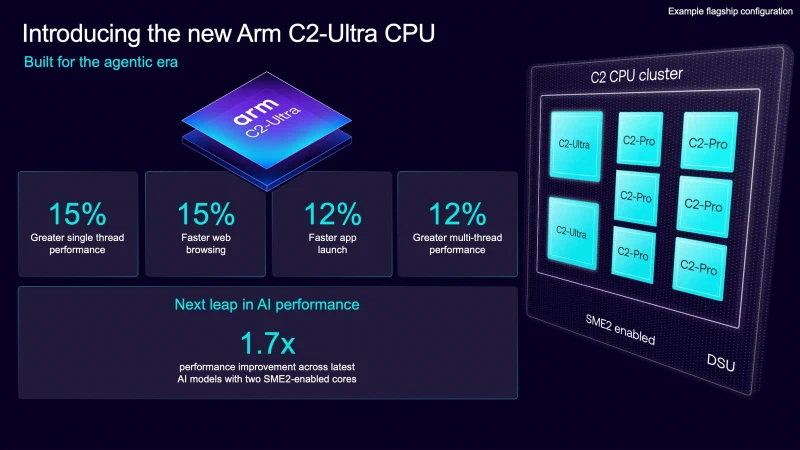
Arm has introduced Arm CSS for Mobile 2, a compute platform for smartphone chips that combines the C2 CPU cluster, the Mali G2-Ultra NX GPU and the SI L2 system interconnect. The C2 cluster pairs C2-Ultra and C2-Pro CPUs with two SME2 units, the Scalable Matrix Extension 2 that speeds up matrix math for AI on the CPU. Arm says this doubles the SME2 capability of the previous-generation configuration and reports up to 1.7x performance across the latest AI models.
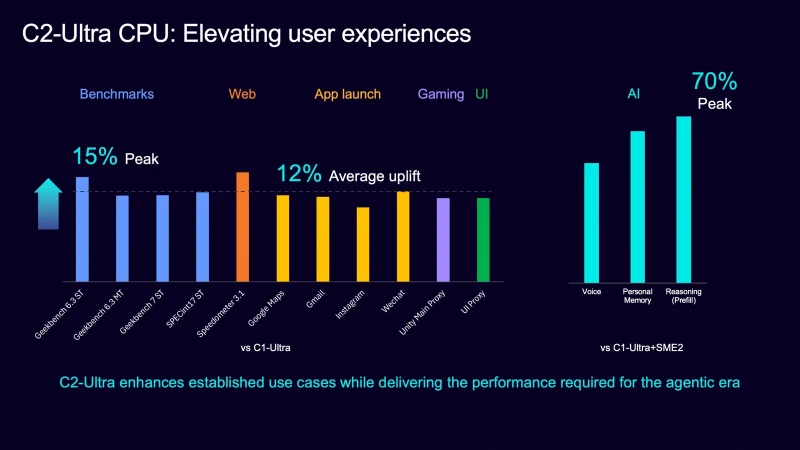
The cluster delivers up to 15% higher single-thread performance, 15% faster web browsing, 12% faster app launch and 12% higher multi-thread performance, Arm reports. For AI, it cites a peak uplift of up to 70% in selected tasks. Its slide compares speech, personal memory retrieval and prefill, the phase where a model reads the prompt, against the C1-Ultra with SME2. In a representative agentic workflow covering speech processing, memory retrieval, reasoning, app execution and web browsing, the C2-Ultra with two SME2 units finishes 24% faster than the previous generation, according to Arm.
Arm's own comparison of the C2-Ultra with the C1-Ultra, with the AI tasks measured against the C1-Ultra with SME2. Source: Arm.
The example flagship configuration in Arm’s slides has two C2-Ultra and six C2-Pro cores. The Mali G2-Ultra NX GPU integrates neural accelerators into its shader cores and adds a new execution engine and a third-generation ray tracing unit for neural graphics. Arm says the SI L2 interconnect provides lower-latency access, higher bandwidth, coherency and quality-of-service controls for CPU, GPU and other resources working at the same time. Partners can use each component on its own or combine them with custom and third-party IP.
Arm's slide for the C2-Ultra CPU with an example flagship cluster layout. Source: Arm.
On the software side, Arm lists KleidiAI, its optimized libraries for Arm CPUs including SME2 paths, plus integrations with common AI frameworks. The Arm AI Portal offers validated models with performance and accuracy data, code examples and deployment resources, and the Arm MCP Server connects them to agentic development tools. vivo says it is bringing Arm Neural Technology to its latest flagship smartphones built on the platform, aimed at mobile gaming. Arm’s post names no launch dates for devices with CSS for Mobile 2.
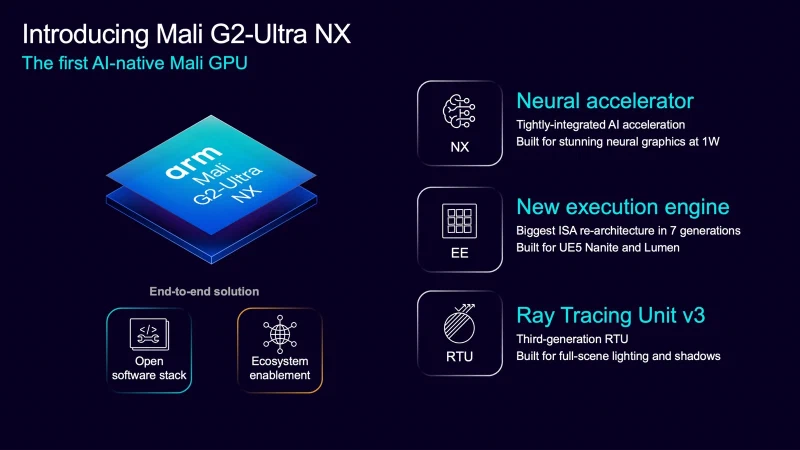
Arm has introduced the Mali G2-Ultra NX, a smartphone GPU that places dedicated neural accelerators inside each shader core. The accelerators reuse the GPU’s memory system, coherent caches and control structures, support INT8 and INT16 processing and include hardware-accelerated optical flow for motion estimation. Arm calls it the first AI-native Mali GPU and positions the accelerators for neural graphics at 1 W. The GPU is part of the Arm CSS for Mobile 2 platform.
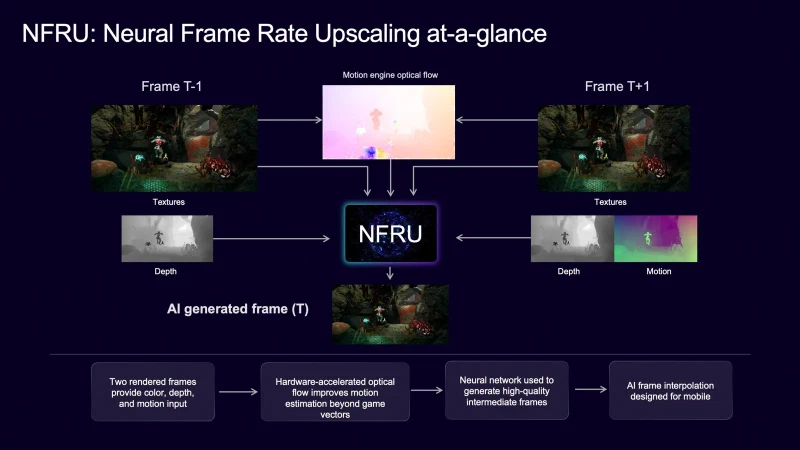
The GPU reaches up to 24% higher benchmark performance than the previous generation and 14% higher performance in non-AI gaming workloads, Arm says. Its neural graphics features are Neural Super Sampling, which reconstructs a higher-resolution image from a lower-resolution render, Neural Frame Rate Upscaling, which generates intermediate frames, and Neural Super Sampling and Denoising, which combines upscaling with denoising for ray-traced scenes. Arm says frame rate upscaling supports up to 120 FPS for longer gaming sessions. In its Neural Dawn demo, Arm reports up to 4x higher performance efficiency and up to 70% lower external memory traffic.
Arm's overview slide for the Mali G2-Ultra NX. Source: Arm.Arm's diagram of how Neural Frame Rate Upscaling builds an intermediate frame. Source: Arm.
The new execution engine is the largest update to the Mali instruction set architecture in seven generations, Arm says, with up to 2x more registers per warp. The third-generation hardware ray tracing unit adds support for Opacity Micromaps, which handle complex transparent geometry. Arm reports up to 13% lower DRAM traffic on ray tracing benchmarks, a 30% higher frame rate and up to 70% less ray tracing work in a scene from Moku’s Central Garden.
For developers, Arm offers the Arm Neural Graphics Development Kit with machine learning extensions for Vulkan, plug-ins for Unreal Engine, an SDK for custom engines and tools for profiling, training and model optimization. Arm names integrations with Tencent Games Central Tech’s Magic Dawn engine, Unity China’s Tuanjie Engine and Unreal Engine MegaLights. Keli Zhou, engine lead for Where Winds Meet, says the game will be among the first to bring Arm Neural Technology to players. Arm’s post names no launch dates for devices with the GPU.
OpenBMB has released MiniCPM5-2B, published on Hugging Face and dated 7 September 2026 in the project changelog. The model card describes a dense Transformer “built for on-device, local deployment, and resource-constrained scenarios”, with 2,516,756,480 parameters of which 1,981,982,720 are non-embedding.
The architecture uses 42 layers with grouped-query attention at 16 query heads and 2 key-value heads, and supports a context length of 131,072 tokens. It is the second model in the MiniCPM5 series after MiniCPM5-1B, scaling the same recipe to a larger footprint.
OpenBMB reports an average score of 53.9 across its evaluation dimensions, including 69.1 on LiveCodeBench, 86.5 on AIME 2025 and 68.1 on NoLiMa. The release is licensed under Apache-2.0 and ships in BF16, GGUF, GPTQ 4-bit, MLX for Apple Silicon and LiteRT-LM for mobile, plus a DSpark draft model for speculative decoding.
Google’s ML Kit GenAI documentation now lists the first devices running nano-v4, 9to5Google reports. The list covers the Pixel 11, Pixel 11 Pro, Pixel 11 Pro XL and Pixel 11 Pro Fold, plus Samsung’s Galaxy Z Flip8, Galaxy Z Fold8 and Galaxy Z Fold8 Ultra.
The same documentation sets Nano v3 or greater as the requirement for Gemini Intelligence, Google’s on-device feature set. According to the report, that requirement first appeared in May 2026, was removed, and has now been reinstated. Listed hardware requirements include 12 GB or more of RAM, a qualified flagship system-on-chip, five or more OS upgrades and six years of security support.
Gemini Intelligence features named in the report include Rambler and Proactive Assistance on Pixel 11, and task automation across more than 40 apps on Samsung’s foldables.
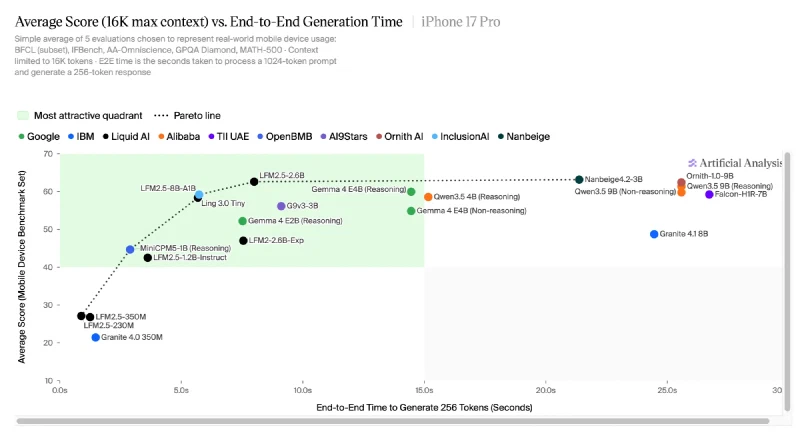
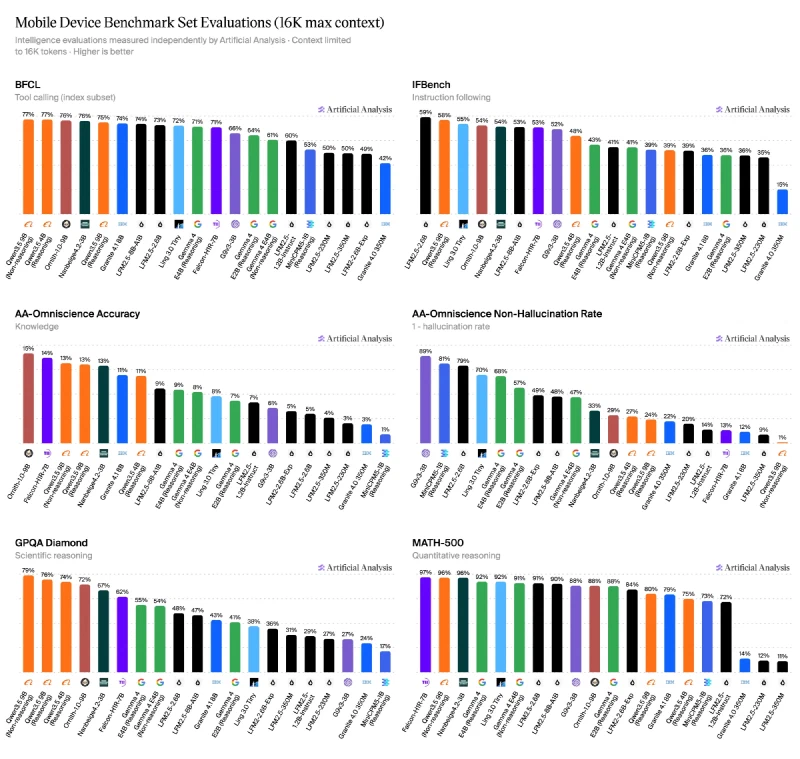
Artificial Analysis has published a benchmark of small language models running locally on an iPhone 17 Pro. The study covers 41 quantised builds, 33 of which ran successfully on the device. Models were executed with llama.cpp at 4-bit quantisation or smaller, and had to fit within 8 GB of memory including the KV cache at 8K context. Artificial Analysis states that the inference benchmarking is operated in partnership with Liquid AI.
Nanbeige4.2-3B and LFM2.5-2.6B tied for the highest intelligence score at 63. On speed and memory the two differ sharply: LFM2.5-2.6B completed the test prompt in 8.0 seconds using 2.3 GB, against 21.4 seconds and 4.0 GB for Nanbeige4.2-3B. Ornith-1.0-9B scored 62 and Qwen3.5 9B (Reasoning) 61.
End-to-end generation time for a 1,024-token prompt plus 256 output tokens ranged from 0.9 seconds for LFM2.5-230M to 26.7 seconds for Falcon-H1R-7B. Peak in-test memory at 4K context ran from 0.4 GB to 6.9 GB. The intelligence index combines tool calling, instruction following, knowledge, scientific reasoning and mathematics. Artificial Analysis notes that context limits, not parameter count alone, held back several 9B models, which frequently hit a 16K ceiling.
Ornith has released Ornith-1.5, a model family with a 9B dense model, a 35B mixture-of-experts model that activates about 3B parameters per token and a 397B mixture-of-experts model. The 9B model also comes as Ornith-1.5-9B-Mobile, which the company says can be deployed on iPhone and Android devices. Ornith gives no size, memory or speed figures for the mobile build.
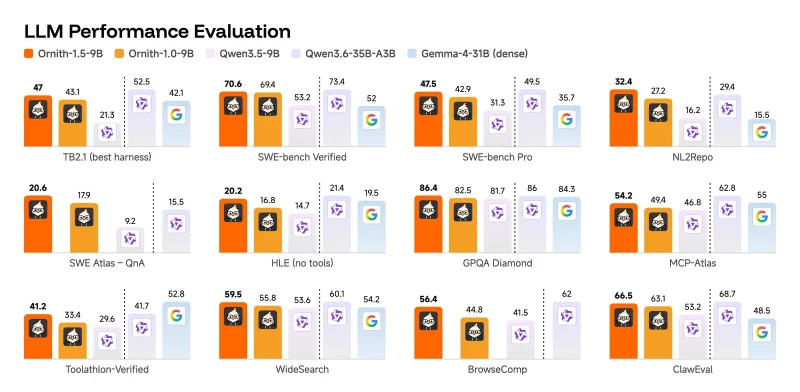
The 9B model scores 47.0 on Terminal-Bench 2.1 with the Claude Code harness and 70.6 on SWE-bench Verified in Ornith’s tests. The company says the model matches or exceeds much larger models such as Gemma 4-31B and Qwen 3.6-35B. In the company’s chart, Qwen3.6-35B-A3B leads on SWE-bench Verified with 73.4 and on Terminal-Bench 2.1 with 52.5, while the 9B model scores 86.4 on GPQA Diamond and 54.2 on MCP-Atlas. The previous Ornith-1.0-9B reaches 43.1 on Terminal-Bench 2.1 in the same chart.
Ornith's own benchmark figures for the 9B model.
According to Ornith, its training loop lets the model propose new tasks, generate task-specific scaffolds and produce solution rollouts, with the reward from the rollouts propagated across all three stages. The company reports that the 35B model scores 67.8 on Terminal-Bench 2.1 with the Terminus-2 harness, against 52.5 for Qwen 3.6-35B. The models are on Hugging Face, with GGUF builds of all three sizes and MLX builds of the 9B and 35B models.
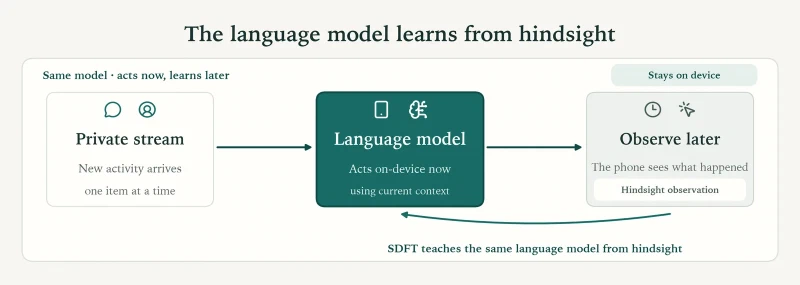
I-Ju Lin and Zhang-Wei Hong published Online-SDFT, a method that keeps fine-tuning a small language model on a phone from the user’s own stream of decisions. On a synthetic notification-routing benchmark with Liquid AI’s LFM2.5-230M, the authors report 70.28% of decisions matching a hidden user preference against 52.78% for the strongest baseline they tested, and cumulative regret of 44.76 against 105.26, over 720 decisions in three paired streams. They state that this comparison ran on Apple MPS rather than on a phone, and that the confidence intervals are nominal across only three streams.
Self-distillation here means the model teaches itself. The model picks an action first, the phone later observes what happened, and the same model is then run again with that outcome added to its input. Its better-informed answer becomes the training target for the version that saw only the original context, so no second teacher model, no human label and no reward score is needed. The authors keep the 230M base frozen and train a LoRA adapter of 172,032 parameters across 48 tensors in six attention layers, with the teacher pass running with the adapter switched off so student updates cannot move the teacher.
Feeding one interaction at a time into so small an adapter makes it noisy and prone to forgetting, so the authors keep a 64-row buffer of recent lessons and sample each batch from it. Their ablation puts that buffer ahead of the exploration schedule as the load-bearing part, with accuracy dropping from 70.28% to 39.58% and regret climbing from 44.76 to 134.90 once replay is removed, while dropping exploration instead leaves accuracy at 69.44% and regret at 62.00.
Diagram: I-Ju Lin and Zhang-Wei Hong.
The repository carries an Android proof of concept in which LFM2.5-230M decides and ONNX Runtime Training performs the adapter update on the device, with replay and checkpoints in app-private storage that survive a restart. Exporting the model still happens on a Linux host, and the deployment guide asks for Android 12 or newer on ARM64 with 12 GB of RAM at minimum, 16 GB preferred, and 8 GB of free storage, because the training graph is FP32.
This video could not be loaded. Use the link below to open it directly.
The authors call that graph a correctness implementation rather than a claim of practical background training on low-memory phones, and state that they did not measure Android latency, peak memory, battery use or thermal behaviour, and that the benchmark uses synthetic streams rather than real users. The code, the Android app and a Colab notebook are on GitHub under the MIT license. No paper or preprint accompanies the release.