Confidant fine-tunes Phi2-2.7B across a phone and two laptops in 40.1 hours
Researchers at Zhejiang University, Zhejiang University of Technology and Hangzhou Dianzi University published Confidant in the ACM MobiCom 2025 proceedings on November 3, 2025, a day before the conference opened in Hong Kong. The framework fine-tunes a language model across several off-the-shelf devices instead of one, and the authors fine-tuned Phi2-2.7B on the Alpaca instruction dataset in 40.1 hours using three of them. Their write-up of that run names a Redmi K50 phone, a Core i7-13650HX laptop and a MacBook Pro with an M1 Pro, while the paper’s abstract and conclusion describe the same result as three mobile devices. The same trio fine-tuned BERT-Base in 2.2 hours.
Confidant cuts a model into consecutive slices, gives each device one slice, and passes activations from one device to the next, so no device ever holds the whole model. Batches flow through that chain as a pipeline, with each device starting a new batch while the devices behind it are still working on earlier ones. The device that holds the training data acts as coordinator and recalculates where the cuts fall during training, using each participant’s measured compute time, free memory and bandwidth, and it discards any split whose slice would not fit in a device’s memory. Inside a device, a second scheduler profiles the CPU and the GPU on varying numbers of attention heads and gives each processor as many heads as it can finish in roughly the same time, which is what the authors credit for running up to 1.94 times faster than a capacity-aware pipeline baseline they implemented themselves, and up to 3.82 times faster than the best single device, both on GPT-2 Medium.
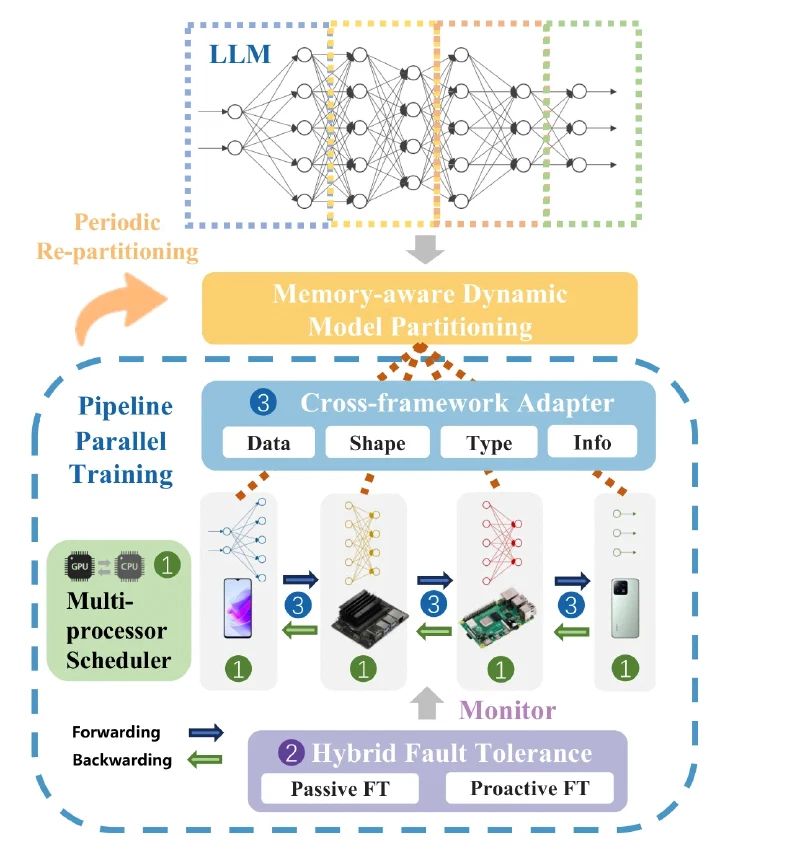
Splitting the model is what brings the footprint per device down. The paper’s memory table puts fine-tuning BERT-Base at a batch size of 8 at 5.5 GB on a single Redmi K50, against a per-device average of 3.17 GB across three devices and 2.43 GB across four. Larger models leave no single-device figure to compare with, because a Redmi K50 fits only 1 of Phi2-2.7B’s 32 transformer blocks at a batch size of 4, and the per-device averages of 15.31 GB for Phi2-2.7B and 32.07 GB for LLaMA3-8B across three devices are carried by the two laptops rather than the phone. A separate table puts the memory PyTorch needs to fine-tune Phi2-2.7B at a batch size of 8 at 46.5 GB, next to the 8 GB to 12 GB of the four phones it lists.
The paper’s prose says Confidant almost does not cause any accuracy drop, while its own model performance table puts the three-device runs at a test loss of 0.66 on Phi2-2.7B and 3.55 on LLaMA3-8B, against 0.52 and 2.86 for fine-tuning the same models the conventional way on a single machine, where a lower loss is better. The four-device runs land at 0.76 and 2.85 on that same comparison, and BERT-Base token classification accuracy holds at 97.66% against 97.70%.
Keeping data on the device is the stated motivation. The authors write that training with Confidant does not require sharing raw data and that devices exchange only intermediate outputs and model gradients, which they present as the privacy argument for their two scenarios, a household assistant fine-tuned on family data during idle hours and a conference assistant fine-tuned on attendees’ phones. They also state that fine-tuning on a single cloud server would be faster and more straightforward, and that their aim is to use idle mobile hardware instead. The Android side is built on Alibaba’s MNN framework with laptops running PyTorch, about 10,900 lines of code in total, the paper is published under a Creative Commons Attribution 4.0 license, and the authors wrote that they planned to release the code in late 2025.