Gemma 3 adds a 1B size that fits in 0.5 GB as an int4 checkpoint
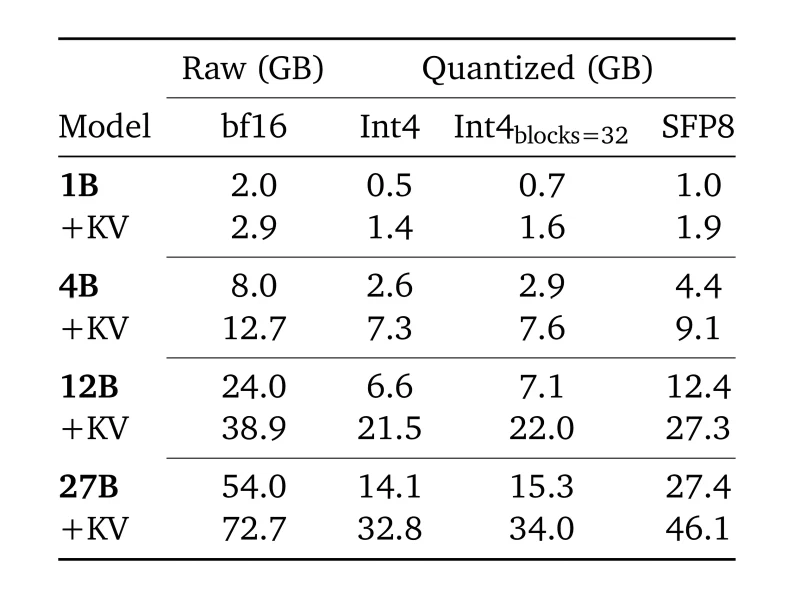
Google released Gemma 3 on March 12, 2025 in four sizes, 1B, 4B, 12B and 27B, and describes them as designed to run fast directly on devices, from phones and laptops to workstations. The 1B is a new size for the line, which started at 2B with Gemma and stayed there through Gemma 2. The technical report puts the 1B at 2.0 GB of weights in bfloat16 and at 0.5 GB as a quantised int4 checkpoint, and the 4B at 8.0 GB and 2.6 GB.
Context length is not the same across the four. The report gives 128K tokens for the 4B, 12B and 27B and 32K for the 1B, with the three larger models pre-trained at 32K and stretched to 128K at the end of pre-training by rescaling their rotary position embeddings. To stop the key-value cache from swallowing memory at long context, Gemma 3 places five local attention layers between each global one and holds the local layers to a 1024-token window, where Gemma 2 alternated one for one. Google reports that in an ablation on a 2B model a global-attention-only configuration carries a 60 percent memory overhead from the cache at a 32K prefill, and that interleaving with a 1024-token window brings that under 15 percent.
Multimodality starts at 4B. The 4B, 12B and 27B share one 400M-parameter SigLIP vision encoder, frozen during training, which takes square images resized to 896 by 896 pixels and condenses each one into 256 tokens for the language model to read. An inference-time step Google calls Pan and Scan cuts non-square or high-resolution images into equal crops and resizes each to the encoder’s resolution, which the report measures as raising the 4B from 72.8 to 81.0 on DocVQA and from 44.1 to 57.0 on InfoVQA in a 4-shot evaluation of a pre-trained checkpoint. The 1B has no vision encoder and takes text only.
Google published quantisation-aware trained checkpoints next to the raw weights, made by fine-tuning each model for about 5,000 steps against the probabilities of the unquantised model, so the weights are trained to tolerate the lower precision rather than rounded down afterwards. The three formats are per-channel int4, per-block int4 and switched fp8, which Google picked for what open source inference engines such as llama.cpp already support. The report’s footprint table counts weights alone and weights plus a key-value cache for a 32,768-token sequence, and on the second measure the 1B needs 1.4 GB at per-channel int4 against 2.9 GB in bfloat16, while the 4B needs 7.3 GB against 12.7 GB.
Google reports its own zero-shot figures for the instruction-tuned models and puts Gemma 3 4B at 43.6 on MMLU-Pro and 75.6 on MATH, against 15.6 and 27.2 for Gemma 2 2B and 56.9 and 55.6 for Gemma 2 27B, with the 1B at 14.7 and 48.0. The 4B also scores 48.8 on the MMMU validation set, a benchmark the text-only sizes do not run, and the report calls the instruction-tuned 4B competitive with the instruction-tuned Gemma 2 27B. Google put every size on Hugging Face, Kaggle and Ollama as a pre-trained and an instruction-tuned checkpoint under the Gemma Terms of Use, and names LiteRT, Gemma.cpp, llama.cpp and Google AI Edge among the runtimes that take them. The same release added ShieldGemma 2, a 4B image safety classifier built on Gemma 3 that labels images for dangerous content, sexually explicit material and violence.