Liquid AI releases LFM2, three CPU-first models from 350M to 1.2B
Liquid AI released LFM2 on July 10, 2025, three open-weight checkpoints of 350M, 700M and 1.2B parameters aimed at the CPUs inside phones, laptops and vehicles. The company reports 2x faster decode and prefill speed on CPU than Qwen3, and describes the models as built for millisecond latency and offline operation on the device rather than in a data centre.
The architecture is a hybrid of 16 blocks, 10 of them gated short convolutions and 6 grouped query attention. A short convolution mixes each token with a handful of its neighbours instead of attending over the whole history, which is cheap on a phone CPU and keeps the attention cache small, while the six attention blocks preserve the recall that pure convolutions lose. Liquid AI says the layout came out of its STAR architecture search, which it ran against measured peak memory and measured prefill plus decode speed on Qualcomm Snapdragon embedded SoC CPUs rather than against proxy metrics.
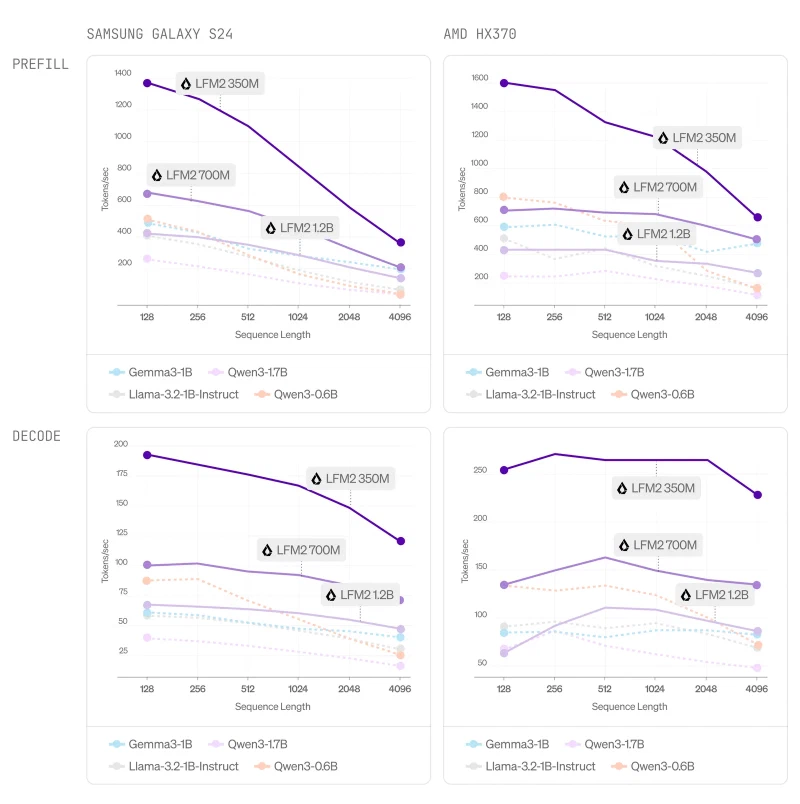
Liquid AI benchmarked the models on a Samsung Galaxy S24 Ultra with a Qualcomm Snapdragon SoC and on an AMD Ryzen HX370 laptop, using Q4_0 in llama.cpp and 8da4w in ExecuTorch. In its llama.cpp charts LFM2-350M clears 1,300 tokens per second of prefill and runs at roughly 190 tokens per second of decode on the Galaxy S24 at a 128-token sequence, falling to around 120 tokens per second of decode at 4,096 tokens. The company states that LFM2-700M stays faster than Qwen3-0.6B on both decode and prefill in both runtimes despite being 16 percent larger, and that the CPU gains should carry over to GPUs and NPUs once kernels are optimised.
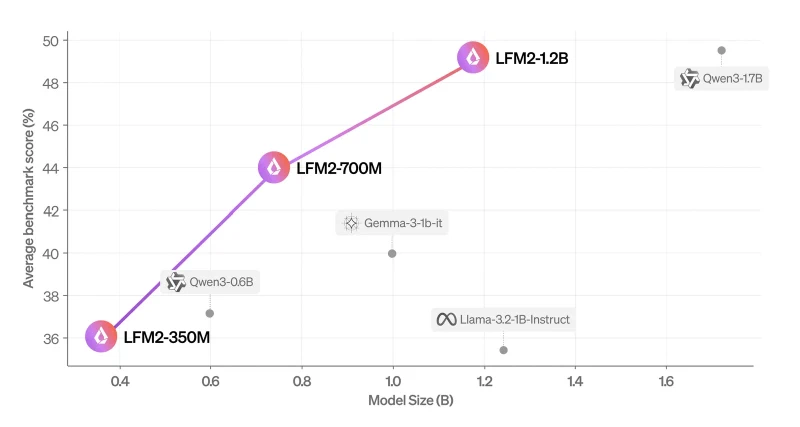
The models are small enough to ship whole, with Liquid AI’s own Q4_0 GGUF builds at 219 MB for LFM2-350M and 696 MB for LFM2-1.2B. On Liquid AI’s internal evaluation table LFM2-1.2B scores 55.23 on MMLU and 74.89 on IFEval against 59.11 and 73.98 for Qwen3-1.7B, a model with 47 percent more parameters, while LFM2-700M reaches 49.9 on MMLU against 40.08 for Gemma 3 1B IT. Liquid AI notes that it evaluated Qwen3 in non-reasoning mode only, on the grounds that reasoning traces run past the output budgets that matter on edge devices.
Weights are on Hugging Face, with the models also reachable through the Liquid Playground and OpenRouter, and Liquid AI points developers at llama.cpp and ExecuTorch for local testing. The licence is an open licence based on Apache 2.0 that permits academic and research use freely and commercial use by companies under $10 million in revenue, with anyone above that threshold directed to contact the company for a commercial licence. All three checkpoints were trained on 10T tokens, roughly 75 percent English, 20 percent multilingual and 5 percent code, with the context extended to 32K during pre-training.
Update, September 23, 2025. Liquid AI added LFM2-2.6B, which widens the stack to 30 blocks, 22 of them convolutions and 8 attention. The company reports 82.41 percent on GSM8K and 79.56 percent on IFEval, and says the model outperforms Llama 3.2-3B-Instruct, Gemma 3 4B IT and SmolLM3-3B. It ships on Hugging Face under the same licence.
Update, November 28, 2025. Liquid AI published an LFM2 technical report covering the dense 350M to 2.6B models plus an 8.3B mixture-of-experts variant with 1.5B active parameters, where only part of the model runs per token. Measuring on a Samsung Galaxy S25 with a Snapdragon 8 Elite in llama.cpp at Q4_0, it reports LFM2-350M at 1,067 tokens per second of prefill and 194.1 tokens per second of decode on a 1K-token prompt, and LFM2-2.6B at 143 and 33.8 against 57 and 17.2 for Qwen3-4B. The report names ExecuTorch, llama.cpp and vLLM as the shipped deployment packages.