LiteRT-LM reports 52 decode tokens per second for Gemma 4 E2B on an Android GPU
Google has detailed LiteRT-LM, the runtime it uses to run Gemma 4 on-device in Chrome, ChromeOS, the Pixel Watch and the Google AI Edge Gallery app. It sits on top of LiteRT, formerly TensorFlow Lite, and adds GenAI libraries over the XNNPACK and ML Drift kernels.
Running Gemma 4 E2B without multi-token prediction, Google measures 52 decode tokens per second on the Android GPU through OpenCL, 56 on iOS through Metal, and up to 76 in the browser on WebGPU. The Android figures come from a Samsung S26 Ultra, iOS from an iPhone 17 Pro, and web from Chrome on a 2024 MacBook Pro with an M4 Max.
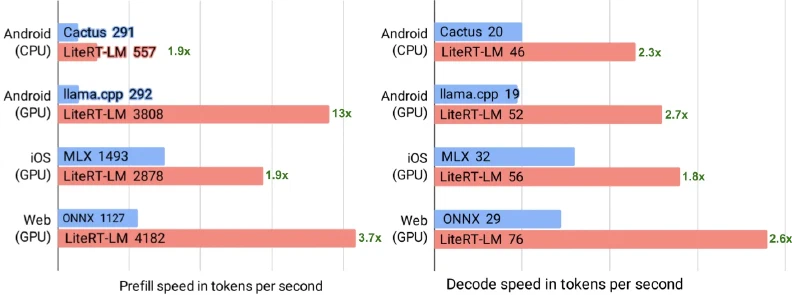
The published comparison puts LiteRT-LM prefill at 3,808 tokens per second against 292 for llama.cpp on the Android GPU, 2,878 against 1,493 for MLX on iOS, and 4,182 against 1,127 for ONNX on the web. Decode figures in the same chart are 52 against 19, 56 against 32 and 76 against 29.
Multi-token prediction raises decode further. Google reports up to a 2.2x speedup, taking Gemma 4 E2B from 52 to 85 tokens per second and E4B from 21 to 47, measured on a Samsung S26 Ultra GPU. The drafter and the primary model run on the same hardware block so the shared KV cache and activations stay in local memory.

On memory, LiteRT-LM keeps per-layer embeddings out of memory and loads image and audio encoders only when a task needs them. Google states that the 2.58 GB Gemma 4 E2B model runs with a physical footprint of 607 MB on Apple mobile CPUs using XNNPACK weight caching.
For agentic use the runtime supports Thinking Mode, which developers can stream to the interface or strip to save KV cache space:
By dedicating a scratchpad for step-by-step reasoning before the model commits to an action, LiteRT-LM can significantly improve the output quality.
Constrained decoding enforces JSON schemas on tool payloads, and native function calling pauses execution, returns the tool-call request to the app and resumes on the tool’s output. Session save and restore serialise KV cache state so long conversations skip the prefill phase on return.
Beyond the existing Kotlin and C++ interfaces on Android, Google is adding an open-source Swift API for Apple platforms and a JavaScript API for the web through WebAssembly and WebGPU.