Google's ML Drift runs Llama 3.1 8B on a phone GPU at 12.7 tokens per second
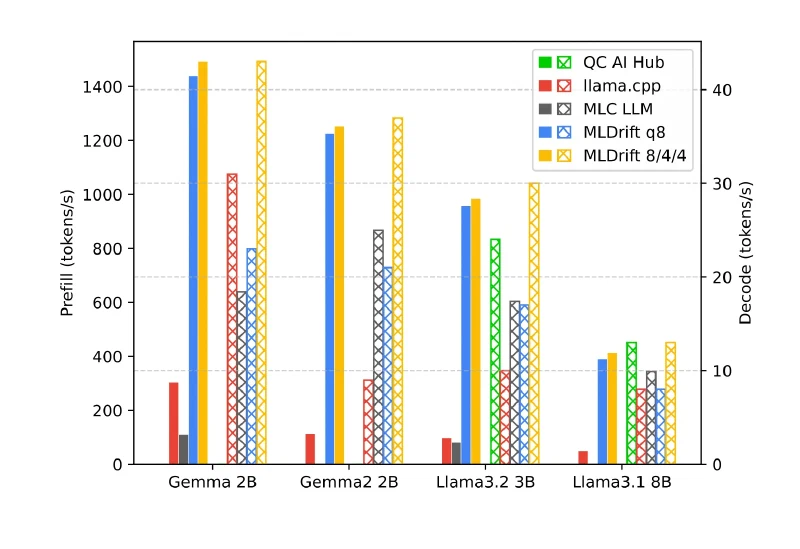
Eight researchers at Google published ML Drift on May 1, 2025, a GPU inference framework for running large generative models on the graphics chip of a phone, a laptop or a Mac. On the Adreno 750 GPU of a Samsung S24, the authors measure 1370 tokens per second of prefill and 37.1 tokens per second of decode for Gemma2 2B, and 412 and 12.7 tokens per second for Llama 3.1 8B. They report a 5 times to 11 times prefill speedup over llama.cpp, MLC LLM and the Qualcomm AI Hub benchmark on Qualcomm GPUs, and the work is due at the CVPR 2025 Workshop on Efficient and On-Device Generation (EDGE).
The team benchmarked five mobile GPUs, the Adreno 830 in a Xiaomi 15 Pro with 16 GB of RAM, the Adreno 750 in a Samsung S24 with 8 GB, the Adreno 740 in a Samsung S23 Ultra with 8 GB, the Arm Immortalis-G720 in a vivo X100 Pro with 16 GB and the Arm Mali-G715 in a Pixel 9 with 12 GB, each at a fixed 1024 prefill and 256 generated tokens. Llama 3.1 8B with every weight at 8-bit ran out of memory on the S24, the S23 Ultra and the Pixel 9 and finished only on the two 16 GB phones, at 7.70 and 4.72 tokens per second of decode. A mixed scheme that holds attention weights at 8-bit and drops embedding and feed-forward weights to 4-bit ran the 8B model on all five devices and lifted decode by up to 1.9 times. ML Drift also treats the two phases of generation separately, since filling the prompt is limited by arithmetic while producing each further token is limited by memory bandwidth.
A mobile GPU constrains inference in ways the paper works through one at a time. Memory comes first, and the authors report that Stable Diffusion 1.4 would need 4.31 GB for its intermediate 16-bit activations, which handing the same buffers to operations whose lifetimes do not overlap cuts to 387 MB. Weight layout comes second, and rearranging weight tensors into slices of four channels that match the 4-element units a GPU computes with buys up to a 20% speedup in matrix multiplication, which the authors call the primary driver of the framework’s advantage. Shader code comes third, and ML Drift writes its kernels once at startup from hand-tuned templates, so the translation between a tensor’s logical indices and the buffer or texture that actually holds it costs nothing while tokens are being produced.
The same engine renders Stable Diffusion 1.4 at 512 by 512 pixels over 20 iterations in 10.96 seconds on the S23 Ultra, under 9 seconds on the S24 and in 3.4 seconds on a laptop with an Intel Lunar Lake Ultra 7 258V. On an NVIDIA RTX 4090 the OpenCL path runs 5% to 25% slower than llama.cpp on CUDA, which the authors put down to NVIDIA’s Tensor Cores being unreachable through OpenCL and WebGPU. The paper names sub-channel quantisation, sparsity and vendor extensions for matrix multiplication as the next steps, and points to no public release of the framework.