ShadowNPU scores attention on the Snapdragon NPU and reports 4.5 times faster inference
Researchers from Peking University and BUPT report up to 4.5 times faster end-to-end inference on a Xiaomi 14 with a Snapdragon 8 Gen 3, and 3.5 times faster on average for the attention kernel alone, with a peak of 6.9 times. The baseline is the arrangement most on-device frameworks use today, float32 full attention running on the CPU or GPU while the rest of the model sits on the NPU. The authors measured Qwen2-0.5B, Qwen2-1.5B, PhoneLM-0.5B and PhoneLM-1.5B on summarisation and two mobile agent tasks, and gave their own system only one of the phone’s middle CPU cores. Against the native attention of llm.npu, which uses four CPU cores or the GPU, they report up to 3.0 times lower latency from that one core. The paper is due at MobiSys 2026.
The starting problem is that attention keeps falling back off the NPU. Attention multiplies three activation tensors together, and mobile NPUs compile a static graph that fixes one quantisation scale factor for a whole tensor, so the authors measure an average 18 percentage point accuracy drop when the operator runs in INT8 on the NPU. Their trade is to stop asking the NPU for the answer and ask it only for the ranking. The NPU computes the query-key scores in INT8 purely to find which tokens matter, which the authors report recovers over 99 percent of the positions a float run would pick, since picking the largest values needs relative magnitudes rather than exact ones. The CPU then computes real attention in float over roughly 20 percent of the tokens and throws the other 80 percent away, at an average accuracy cost of 0.4 percentage points against the float baseline. Each attention head gets its own sparsity ratio, fixed by an offline profiling run the paper puts at about five minutes on a single A100.
On a Redmi K60 Champion Edition with a Snapdragon 8 Gen 2 the authors read battery voltage and current from the kernel and report a single attention kernel at 1024 tokens dropping from 8.59 J to 1.12 J for PhoneLM-1.5B, a factor of 7.66. Speedups on that older phone are smaller, 2 times, 1.25 times and 1.22 times across the three datasets, which the authors attribute to its Hexagon V73 NPU against the V75 in the Xiaomi 14. The paper reports no memory footprint figures. It does report that end-to-end inference time on the Xiaomi 14 stayed between 14.5 and 15.5 seconds while the phone was also taking photos, playing video, playing music or running a shopping app, since the LLM work is not competing for the cores those apps use.
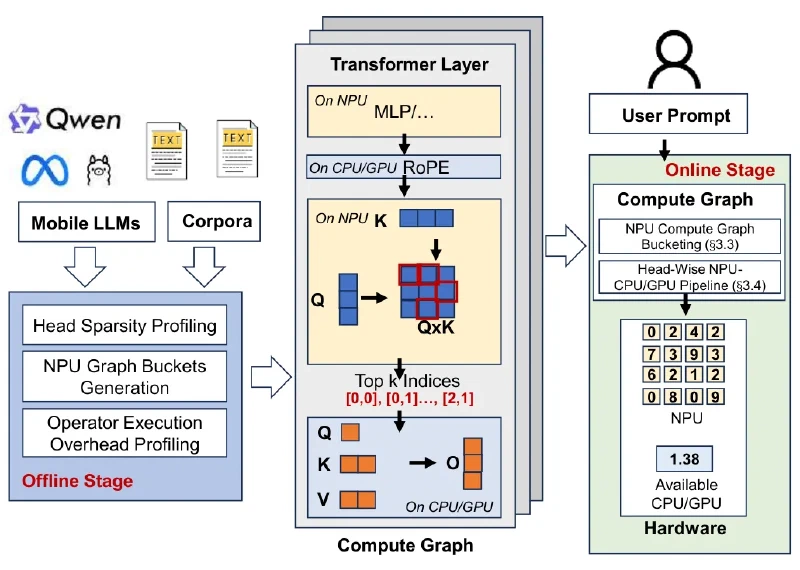
The authors state a prototype of more than 10,000 lines of C++ and Python, built on Qualcomm’s QNN and Hexagon SDK for the NPU side and integrated into llm.npu, which they call the only fully open-source framework running on NPUs. The paper names no repository and announces no artefact release, and the title calls the system ShadowNPU while the text throughout calls the module shadowAttn. The arXiv listing carries a CC BY 4.0 license. For a hands-on point of comparison on the same silicon family, a user test of llama.cpp’s Hexagon NPU backend on a Snapdragon 8 Gen 3 phone put generation at about the same speed as the chip’s CPU, without the heat.