MIT HAN Lab publishes TinyChatEngine for 4-bit LLMs on laptops and Raspberry Pi
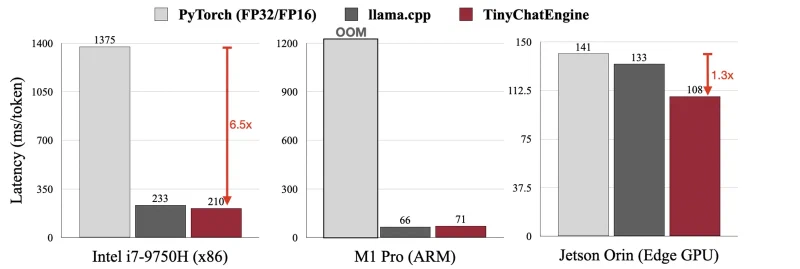
Song Han’s group at MIT pushed the first commit of TinyChatEngine on August 24, 2023, according to the repository’s commit history. The library runs quantised language models in plain C and C++ with no dependency on bulky libraries, and the README names x86 CPUs from Intel and AMD, ARM devices including Apple M1 and M2 Macs and the Raspberry Pi, and Nvidia GPUs through CUDA. The lab’s own slides put LLaMA2-7B at 71 ms per token on an M1 Pro and 210 ms per token on an Intel i7-9750H laptop CPU.
The compression behind it comes from two papers by the same lab. AWQ, for activation-aware weight quantisation, was submitted on June 1, 2023 and works from the finding that protecting only 1 percent of the weights, picked by looking at the activation distribution rather than the weights themselves, keeps most of the accuracy at 4 bits. SmoothQuant, submitted on November 18, 2022, handles 8-bit weights and 8-bit activations by shifting the hard part of the job from activations to weights through a mathematically equivalent transformation, and its authors report up to 1.56x speedup and 2x memory reduction.
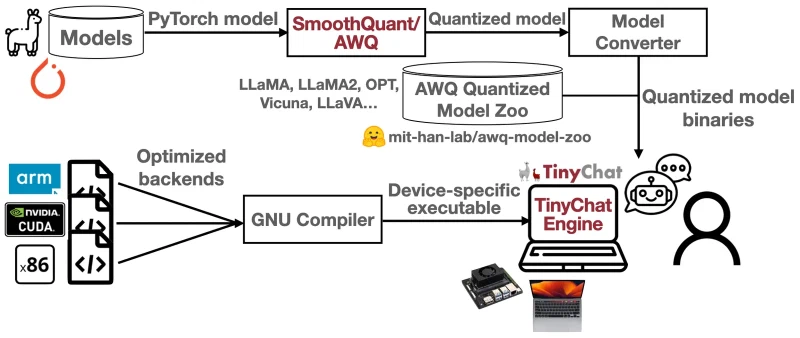
The backend table lists W4A32, W4A8 and W8A8 on both x86 and ARM CPUs, W4A16 on Nvidia GPUs, and FP32 on CPU. TinyChatEngine reorders the 4-bit weights offline during model conversion rather than at runtime, in a layout tailored to each instruction set, with QM_ARM built for 128-bit SIMD and QM_x86 for 256-bit SIMD. The slides state that expanding the 4-bit weights to int8 and using int8 SIMD multiply-accumulate instead of FP32 gives 1.3x on the Intel i7-9750H and 3x on the M1 Pro.
For the device comparison the lab measured LLaMA2-7B against PyTorch and llama.cpp. On the Intel i7-9750H it reports 210 ms per token for TinyChatEngine, 233 for llama.cpp and 1375 for PyTorch, which it labels a 6.5x gap. On an Nvidia Jetson Orin the figures are 108, 133 and 141 ms per token, and on the M1 Pro TinyChatEngine lands at 71 ms per token against 66 for llama.cpp, with PyTorch running out of memory. The lab publishes no Raspberry Pi timing.
The model zoo ships LLaMA-7B, LLaMA2-7B-chat and LLaMA2-13B-chat plus OPT at 125M, 1.3B and 6.7B, in FP32, AWQ int4 and SmoothQuant int8 variants, with a download script that takes a per-device quantisation flag. macOS users install boost and llvm through Homebrew, and Xcode for the Metal compiler that enables Apple GPU support. The repository carries an MIT license, added the day after the first commit. For the Raspberry Pi the project recommends a board with 8 GB of RAM and says its testing ran on a Raspberry Pi 4 Model B Rev 1.4 with aarch64.